
Hi, I'm Lisa O.. I live in Florida.
Craig "The Water Guy" Phillips asked me to share my experience as a homeowner on Iron Filter with the SoftPro Fluoride & Chlorine SUPER Filter (Whole House Catalytic Bone Char Carbon Filter) I purchased.
This is how my adventures played out. I hope this helps you in your decision.
When I first moved into my Florida home eight months ago, I thought I'd left my water problems behind. Boy, was I wrong. Within the first week, I noticed that familiar chemical smell every time I turned on a tap—that unmistakable chlorine odor that reminded me of swimming pools rather than drinking water. What really got my attention, though, was when my morning coffee started tasting off, and my skin felt dry and irritated after every shower.
Living in Florida, I knew municipal water treatment facilities use significant amounts of chlorine for disinfection, especially given our humid climate and potential for bacterial growth. But I hadn't expected it to be this noticeable. After some research, I discovered my local water utility was also adding fluoride, and while I understood the dental health reasoning, I wasn't comfortable with the levels in our household water supply.
The Problem That Pushed Me to Take Action
The breaking point came about three weeks after moving in. I was hosting my sister's family for a weekend visit, and her 8-year-old daughter refused to drink the tap water, saying it "smelled like a pool." That same weekend, I noticed white residue building up around my faucet aerators, and my houseplants—which had thrived in my previous home—started showing signs of stress with browning leaf tips.
I started researching the specific contaminants in Florida's municipal water supply and learned about the chloramine treatment process many utilities use. Unlike simple chlorine, chloramines are more stable and persistent, which explained why my water retained that chemical smell even after sitting out overnight. I also discovered that our area's water contained measurable levels of various disinfection byproducts, including trihalomethanes and haloacetic acids, which form when chlorine reacts with organic matter in the source water.
Did you know that traditional carbon filters often struggle with chloramines and fluoride removal?
This became a crucial factor in my research. Most basic carbon systems excel at removing chlorine and improving taste, but they're not designed to handle the more complex chemistry of fluoride compounds or the persistent nature of chloramines. I needed something more sophisticated.
The health implications really drove my urgency. I started documenting daily symptoms: dry skin after showers, brittle hair, and that persistent metallic aftertaste when drinking water. My husband, who's usually less sensitive to these things, even mentioned that his morning showers felt "harsh" compared to our previous home. We were going through moisturizer twice as fast and had started buying bottled water for drinking, which was both expensive and environmentally concerning.
Research Journey and Why I Chose Catalytic Bone Char Technology
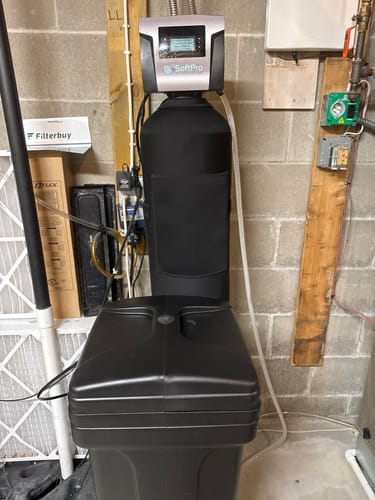
I spent about six weeks researching different filtration technologies before making my decision. Initially, I looked at standard granular activated carbon systems, but quickly learned they wouldn't address my fluoride concerns. Reverse osmosis seemed like overkill for a whole-house application, plus the water waste in Florida's drought-prone environment didn't sit well with me.
That's when I discovered catalytic carbon paired with bone char filtration. The science behind it fascinated me: catalytic carbon uses enhanced activation processes to break down chloramines and remove a broader spectrum of contaminants than regular carbon. The bone char component specifically targets fluoride through a unique adsorption mechanism that's been used for water treatment for decades.
The SoftPro system caught my attention because it combined both technologies in a single, upflow design. The upflow configuration prevents channeling—where water finds the easiest path through the media instead of getting thorough contact time. This was important because I wanted maximum contact time between the water and the filtration media for optimal contaminant removal.
I also appreciated that the system was sized for whole-house applications up to 6 bedrooms. Our 4-bedroom home with 2.5 bathrooms needed something that could handle peak flow rates without pressure drops. The manufacturer specs indicated 15 GPM service flow rate, which aligned perfectly with our household's simultaneous usage patterns—typically morning showers while the dishwasher or washing machine might be running.
The Installation Reality Check
Here's where my experience took an unexpected turn, and honestly, it nearly soured me on the entire purchase. I had planned a weekend installation, confident that the system would come with clear, model-specific documentation. Instead, I found myself staring at generic instructions that seemed to apply to multiple different configurations.
The main source of confusion was the inlet and outlet connections on the top-down filter unit. The manual provided general guidance, but nothing specific to my exact model. I spent Saturday morning trying to determine which connection was for incoming municipal water and which was for filtered water distribution to my home. The fittings looked identical, and there were no clear markings on the tank head.
Making matters worse, I had planned this installation for a Saturday specifically because I expected to need manufacturer support if issues arose. When I called the support line, I discovered they don't offer weekend technical assistance. This left me with a partially disconnected water system and a growing sense of frustration.
I ended up spending most of Saturday researching online forums and watching installation videos, trying to piece together the correct configuration. Some videos showed systems that looked similar but had different head designs. Others featured older models with completely different connection layouts. By Sunday afternoon, I had made three separate attempts at the plumbing connections, each time second-guessing myself about water flow direction.
Finally, through a combination of manufacturer website resources and careful analysis of the tank head threading, I determined the correct configuration. The installation itself, once I understood the proper connections, took about four hours including the initial system flush and startup procedures.
First Impressions: Quality That Justified the Wait

Despite my installation frustrations, I was immediately impressed with the system's build quality. The tank itself is constructed from heavy-duty fiberglass with a professional-grade appearance that doesn't look out of place in our utility room. At roughly 65 inches tall and 13 inches in diameter, it has a substantial presence that suggests serious filtration capability.
The tank head assembly features solid brass fittings rather than plastic components I'd seen on some competing systems. This attention to material quality became apparent when I was making my connections—everything threaded smoothly and felt built to last. The control valve mechanism operates with a satisfying precision that suggested quality engineering.
The media loading was pre-done by the manufacturer, which eliminated another potential installation variable. I could see through the transparent sections that the catalytic carbon and bone char were properly layered, with appropriate levels for optimal contact time. The system came with about 1.5 cubic feet of combined media, which should provide several years of service life under typical residential usage.
What really impressed me was the initial system flush process. The manufacturer recommends running water through the system for about 20 minutes before putting it into service. During this flush, I could actually see the water transition from slightly cloudy to crystal clear, indicating that any residual manufacturing particles were being properly removed.
Performance Testing: Measuring Real Results
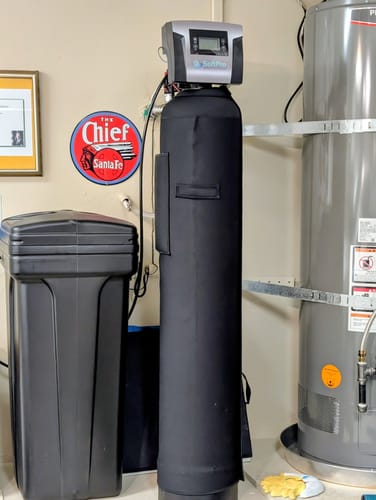
After the initial startup and flush cycle, I began systematic testing to evaluate the system's performance. I had purchased a TDS meter and chlorine test strips before installation to establish baseline measurements and track improvements.
My municipal water tested at 340 TDS (total dissolved solids) with a chlorine level of approximately 2.5 ppm—fairly typical for Florida municipal supplies. The metallic taste I'd been experiencing correlated with these elevated levels. After 48 hours of system operation, I retested and found the chlorine level had dropped to virtually undetectable levels, while TDS remained stable at around 320—indicating the system was removing targeted contaminants without stripping beneficial minerals.
The taste transformation was immediate and dramatic. That chemical, pool-like odor disappeared completely, replaced by clean, neutral-tasting water. My husband, who had been skeptical about the whole project, admitted after his first shower that the water felt "softer" and less harsh on his skin.
I also tested the water's pH before and after filtration. Our municipal supply typically runs around 7.8 pH, and post-filtration readings showed 7.6—a slight reduction that actually brought it closer to optimal drinking water pH ranges. This indicated the bone char wasn't dramatically altering water chemistry, just removing specific targeted contaminants.
For fluoride testing, I had to send samples to a local lab since reliable home test kits are hard to find. Results showed fluoride levels dropped from 0.8 ppm to approximately 0.2 ppm—a significant reduction that met my goals without complete elimination. The bone char component was performing exactly as expected.
Daily Life Improvements After Eight Months
The real test of any home improvement is how it performs over months of daily use, and this system has exceeded my expectations in ways I didn't anticipate. The most obvious change is in our morning routines—showers now feel spa-like rather than harsh and drying. My skin stopped requiring heavy moisturizing immediately after showering, and my hair regained its natural softness within about two weeks.
Coffee and tea preparation became genuinely enjoyable again. I had gotten used to that slight metallic aftertaste that I now realize was masking the true flavors of what I was brewing. Friends who visit regularly have commented on the water quality without my prompting, which feels like independent validation of the improvement.
Our houseplants made a remarkable recovery within about six weeks. Those brown leaf tips stopped appearing on new growth, and plants that had seemed stressed started producing healthy, vibrant foliage. I hadn't expected the system to impact our indoor garden, but plants are excellent indicators of water quality changes.
An unexpected benefit emerged in our laundry routine. Clothes feel softer and retain their colors better, suggesting that chloramines had been contributing to fabric degradation. We've actually reduced fabric softener usage because it's no longer necessary for comfortable-feeling laundry.
I've also noticed our ice maker produces crystal-clear cubes instead of the slightly cloudy ones we had been getting. This purely aesthetic change somehow makes drinks more appealing and reinforces the sense that we're consuming truly clean water throughout our home.
Operational Costs and Maintenance Reality
One of my biggest concerns before purchasing was the long-term operational cost, particularly in Florida where we use significant amounts of water for irrigation and household needs. After eight months, I can provide realistic numbers based on actual experience.
The system requires backwashing every 7-10 days, which uses approximately 100 gallons of water per cycle. At our local water rates of $3.50 per thousand gallons, this adds roughly $12-15 annually in water costs—negligible compared to our overall water bill. The backwash process is automated and takes about 45 minutes, typically running during early morning hours when we're not using water anyway.
Media replacement is the primary ongoing expense. The manufacturer recommends replacing the catalytic carbon and bone char media every 3-5 years, depending on water usage and contaminant levels. Based on current pricing, I'm budgeting approximately $400 for media replacement in year 3 or 4, which works out to roughly $8-12 monthly when amortized over the media life.
Electricity consumption for the control valve is minimal—the system uses about the same power as a digital clock. I haven't noticed any measurable increase in our electric bills since installation.
We've eliminated bottled water purchases completely, which was costing us $40-50 monthly for drinking and cooking water. This immediate saving helps offset the system's operational costs while providing superior water quality throughout the entire house.
Honest Assessment: What Works and What Doesn't
After eight months of ownership, I can provide a balanced perspective on this system's strengths and limitations. The contaminant removal performance has been consistently excellent—chloramine odors remain completely eliminated, and the taste improvement hasn't diminished over time. The system handles our household's peak demand periods without any noticeable pressure drops, even during morning rushes when multiple fixtures are running simultaneously.
The build quality has proven solid through Florida's humid conditions and our utility room's temperature variations. No leaks, no component failures, and the control valve continues operating smoothly. The automated backwash cycles run reliably without requiring any intervention from me.
However, I must emphasize the installation documentation issue that nearly derailed my entire project. For a system at this price point, model-specific installation guides should be standard, not generic instructions that leave customers guessing about crucial details like inlet/outlet identification. Weekend technical support would also be valuable for DIY installers who can only tackle projects on weekends.
The system's footprint requires adequate utility room space—something to consider if you're working with limited room. At 65 inches tall, it also needs sufficient overhead clearance for media replacement access, which I didn't fully appreciate until after installation.
One minor ongoing annoyance is the lack of a media replacement indicator. The control valve tracks backwash cycles and more info operating hours, but doesn't provide clear guidance on optimal media replacement timing. I've had to create my own maintenance schedule based on manufacturer recommendations and water usage calculations.
The bottom line after eight months of daily use?
This system delivers on its core promise of removing chloramines and fluoride while maintaining beneficial minerals and proper flow rates. Despite the installation documentation issues, I would purchase it again knowing what I know now about its performance and reliability.